
Key Takeaways
Decision Snapshot
For distributors and importers buying a full dance floor inventory, container planning must connect panel quantity, module format, packing unit, pallet dimensions and shipment documents. This guide sets out the published panel data, the 25-panel flat-trolley and 10-panel flight-case packing references, the carton and pallet option, and the quotation inputs needed before a container count can be approved.
- The published specification table gives distributors the metric dimensions and panel weights needed to build a shipment worksheet before requesting a packing plan.
- The flat-trolley reference is 25 panels per unit. The flat trolley is intended for efficient movement of multiple panels rather than acting as a substitute for a confirmed pallet plan.
- The flight-case reference is 10 panels per unit. This protected packing option changes the number of panels carried by each handling unit and must be reflected in the order.
- Carton and pallet packaging are published shipment options. The final pallet count still depends on carton dimensions, pallet dimensions and the loading arrangement confirmed for the order.
Decision basis: A distributor can calculate nominal panel area and panel-content weight from the published specifications, but those calculations do not establish loaded container cube or the number of pallets.
Published packing unit: Packing quantities describe what fits into one flat trolley or flight case; they do not, by themselves, state how many such units can be loaded into a container.
Shipping Snapshot
- A container count should be approved only after the supplier confirms the pallet schedule, outer pallet dimensions, loaded arrangement and handling method.
- Pallet requests should separate the dance floor panel mix from edging, corners, walkway corners and any stage deck or riser included in the same shipment.
- The purchase order should name the packing method instead of using an open instruction such as “ship economically,” which leaves the distributor without a defined receiving unit.
Container count: The defensible answer is the number of containers supported by the confirmed loaded pallet plan. Publishing a container total without the outer dimensions and loading data would replace an order input with an unsupported estimate.
Purchase-order readiness: A distributor can move from product selection to shipping when the panel mix, accessory quantities, packing format, pallet count and carton identification are written into the order.
Published Panel Data
Module footprint and weight
The non-holes dance floor panel range provides the dimensions and weights used in this shipping model. Panel dimensions matter because they determine the installed footprint and help compare module formats. Panel weight matters because a distributor must distinguish the weight of the floor inventory from the gross weight after packaging.
Published module dimensions: The comparison uses length, width and thickness for each panel format. These values support area calculations and provide the first check against a proposed packing list.
Weight basis: The listed weights are per panel, not per pallet, trolley or flight case. A packing-unit estimate must therefore multiply the relevant published panel weight by the number of panels assigned to that unit.
| Component | Length (cm) | Width (cm) | Thickness (cm) | Weight per piece (kg) | Nominal area (m²) |
|---|---|---|---|---|---|
| Four-foot panel | 122 | 122 | 2 | 19.5 | 1.4884 |
| Three-foot panel | 91 | 91 | 2 | 11.8 | 0.8281 |
| One-metre panel | 100 | 100 | 2 | 13.5 | 1.0000 |
| Four-foot straight edging | 122 | 7 | 2 | 0.9 | — |
| Three-foot straight edging | 91 | 7 | 2 | 0.7 | — |
| One-metre straight edging | 100 | 7 | 2 | 0.8 | — |
| Four-foot corners and walkway corners | 129 | 7 | 2 | 0.9 | — |
| Three-foot corners and walkway corners | 98 | 7 | 2 | 0.7 | — |
| One-metre corners and walkway corners | 107 | 7 | 2 | 0.8 | — |
The comparison shows why a distributor should not order by module name alone. The four-foot panel has the largest listed face dimensions and the highest listed panel weight, while the three-foot panel has the lowest listed piece weight. The chosen mix determines both the installed layout and the amount of product assigned to each handling unit.
Edging, corners and walkway corners
Edging set: Straight edging is listed separately from the panels. Its published length follows the matching module, while its width and thickness remain much smaller than the panel face dimensions.
Corners: Corner pieces are longer than the corresponding straight edging in the published table. A distributor should assign them to the layout before calculating accessory cartons, rather than treating all perimeter parts as equivalent strips.
Walkway corner: The listed walkway-corner dimensions and weights correspond to the matching corner rows. The purchase order should still identify walkway corners separately because their intended position differs from an ordinary perimeter corner.
Because edging and corner pieces have their own listed dimensions and weights, the packing plan should keep them identifiable while allowing the supplier to consolidate them where the approved packing method allows. That prevents a full panel count from being confused with the complete floor package.
Packing Formats
Flat trolley
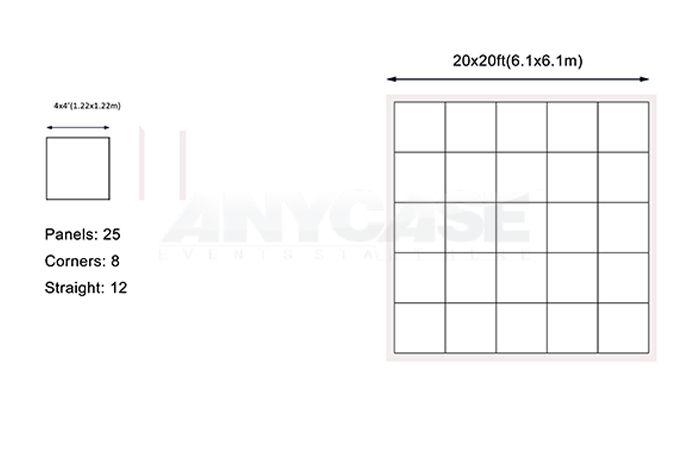
Flat trolley: The published flat-trolley reference is 25 panels. The ANYCASE dance floor range lists flat trolley as a transportation option designed for moving multiple panels efficiently. For a distributor, the relevant question is whether the quoted order will use complete trolley units, partial units or another arrangement.
Working assumption: If all 25 panels are four-foot panels, the published values produce a panel-content weight of 25 × 19.5 = 487.5 kg. Their nominal rectangular face area is 25 × 1.4884 = 37.21 m². These are arithmetic illustrations for that stated mix, not figures for the trolley’s gross weight or outer cube.
That distinction protects the shipment calculation. The 25-panel figure describes the packing quantity, while 487.5 kg describes only the panels inside the unit. Trolley structure, protective material and any pallet beneath it must come from the confirmed packing list.
Flight case
Flight case: The published flight-case reference is 10 panels. The flight case page describes protected transportation for touring and frequent handling, making it a relevant option when the distributor values a defined protective enclosure over the larger panel count of a flat trolley.
Protected-unit tradeoff: Using the four-foot panel figures as a conditional example, 10 panels weigh 10 × 19.5 = 195 kg. Their nominal rectangular face area is 10 × 1.4884 = 14.884 m². These calculations exclude the flight-case shell, foam, fittings and any external pallet.
The direct packing comparison is therefore 25 panels in a flat trolley against 10 panels in a flight case. That difference changes the number of handling units required for a fixed panel order and must be reflected before the supplier calculates container space.
Carton and pallet packaging
Carton and pallet: Carton and pallet packaging are listed for shipment and container transportation. This route is suitable when the distributor needs cartons prepared for warehouse storage and pallets presented as the outward handling unit.
Pallet request: A distributor should request the number of cartons on each pallet, the pallet dimensions, the loaded pallet weight and the number of pallets in the shipment. Those fields should appear in the quotation rather than being left for the receiving warehouse to discover.
For other equipment that shares the outbound facility, a custom road case may be reviewed as a separate protected-transport option. It should not be added to the panel pallet count unless it forms part of the same confirmed shipment schedule.
Worked Shipment Model
Panel area
Panel area: Area calculation provides a common basis for comparing module formats. A four-foot panel measures 122 × 122 cm, which equals 1.4884 m². A three-foot panel measures 91 × 91 cm, which equals 0.8281 m². A one-metre panel measures 100 × 100 cm, which equals 1.0000 m².
Packed area: Panel area is the sum of the visible floor faces; it is not the same as the space occupied by the packed shipment. The packing calculation must also account for each unit’s outer dimensions, orientation and the space used to handle it.
The area figures are useful for checking an intended layout before purchase. They should not be added to carton or pallet volume without an outer-dimension schedule, because the two measurements describe different things.
Packed weight
Packed weight: The following table shows the arithmetic result when every panel in the unit is a four-foot panel. It compares published packing quantities using the calculated panel area and panel-content weight.
| Packing unit | Panels per unit | Panel-content weight (kg) | Nominal panel area (m²) |
|---|---|---|---|
| Flat trolley | 25 | 487.5 | 37.21 |
| Flight case | 10 | 195 | 14.884 |
Weight limitation: The table does not state gross shipping weight. It contains the published panel weight multiplied by the published packing quantity, so the freight quotation must add packaging, pallets and any other confirmed shipment items separately.
Because the flat trolley holds more panels than the flight case, its conditional panel-content weight and nominal area are also higher. The correct format still depends on handling, protection and the order’s approved packing method.
Pallet count
Pallet count: Pallet count is calculated from the confirmed carton arrangement, not directly from panel count. The supplier should state how many cartons fit on each pallet, how many panels and accessories are inside each carton, and how many loaded pallets make up the order.
A useful RFQ includes both a product schedule and a logistics schedule. The product schedule states module formats and quantities. The logistics schedule states packing units, cartons per pallet, pallet dimensions, loaded weights and any separate handling units.
Distributors combining event flooring with other modular equipment should also check the portable stage range. Stage deck and riser products may use different cartons, protection and pallet heights, so their freight should not be inferred from the dance floor panel figures.
Turning the Worksheet Into a Container Plan
Required quotation inputs
Container cube: The published dance floor data does not state the outer cube of each carton, pallet, trolley or flight case. The supplier should provide the dimensions of the actual outward unit used for the order.
Load plan: Ask how loaded pallets are arranged in the container and whether every pallet has the same orientation. The response should also identify whether a trolley or flight case is loaded directly, grouped with other units or placed on a separate base.
Freight-ready list: A distributor should request the panel quantity by format, accessory quantities, packing format, carton count, pallet count, outer pallet dimensions, loaded weight per pallet and the proposed container sequence.
These inputs connect the published product figures to the shipment quotation. Once the actual outward dimensions and loading plan are supplied, the container count can be checked against the confirmed capacity of the selected container rather than against panel area alone.
Utilization and handling
Container utilization: Divide the required loaded-unit space by the usable space defined in the confirmed loading plan. The result is a planning check, not permission to fill the remaining volume with unlisted equipment.
Packing-unit fit: A flat trolley and a palletized carton order are different handling structures. The quotation should state whether the trolley travels as an individual unit, how it is protected and whether it consumes an independent floor position in the container.
Final-mile handling: A distributor should consider whether the receiving warehouse can move the specified unit directly to storage or must break down cartons first. The same question applies to a flight case that protects panels through touring but may require a different handling plan at destination.
Container utilization should therefore be checked alongside the destination workflow. A shipment that fits in the proposed container remains operationally weak if its outward units cannot be accepted or moved as planned.
Distributor purchase order
Panel mix: Write the module format and quantity as separate purchase-order lines. A distributor distributing to several customers may also request a carton allocation by destination before the outer pallets are committed.
| Order section | Required statement | Distributor check |
|---|---|---|
| Dance floor panels | Module format and panel quantity | Matches the intended layout and area calculation |
| Edging and corners | Straight edging, corners and walkway corner quantities | Identifiable accessory cartons |
| Packing | Flat trolley, flight case, carton or pallet method | Defines the outward handling unit |
| Pallets | Loaded pallet dimensions, weight and sequence | Matches the container loading plan |
| Documents | Carton list, packing list and shipment schedule | Supports receiving and inventory allocation |
Packaging instruction: State the accepted packing method and the documents required on dispatch. Avoid leaving the final format open after the panel price has been approved.
Pallet schedule: Attach the pallet schedule to the order so that the commercial offer and physical shipment describe the same inventory. Include the stage deck and stage riser lines separately when those products share the shipment.
Cross-referencing the LED starlit dance floor range or the round dance floor range should be handled as a separate product quotation when their packing structures differ from the published non-holes panel table.
ANYCASE Packaging and Order Process
Capability
Packaging support: ANYCASE lists carton and pallet packaging alongside flat trolley and flight case options. Packaging can be discussed according to order quantity, the customer’s warehouse, transportation and installation workflow. The published packing references are 25 panels for the flat trolley and 10 panels for the flight case.
The design and sales teams can review a package request before production. The review should confirm the floor layout, module mix, accessory requirement, destination handling needs and the packing format that will appear on the order.
This process gives the distributor a defined handling unit instead of an open shipping instruction. It also creates a traceable link between the panel schedule and the pallet or carton schedule.
Order sequence
Design and sales process: The practical sequence starts with the required panel quantity and layout. The team then confirms edging, corners and walkway corners, selects the packing option, reviews the pallet schedule and records the dispatch documents.
Order sequence: The final handoff consists of the approved product mix, packing method, carton or pallet schedule, loaded dimensions and weights, and the shipment document set. Each element should match the others before the container count is fixed.
That sequence is especially important when a distributor compares packing formats. The 25-panel and 10-panel references are useful planning inputs, while the confirmed pallet and container schedule converts those inputs into an executable shipment.
FAQ
Product and layout questions
Does a 25-panel trolley tell me how many containers I need?
Answer: No. The 25-panel figure establishes the flat-trolley packing quantity, but it does not provide the trolley’s outer dimensions or a container loading plan. The container count must follow confirmation of the actual outward units, their loaded dimensions and their arrangement.
Can 25 flat-trolley panels and 10 flight-case panels be compared directly?
Answer: Yes, but only as packing-unit references. Under a four-foot-panel illustration, the flat trolley carries 487.5 kg of panels across 37.21 m², while the flight case carries 195 kg across 14.884 m². Packaging weight and outer cube remain separate inputs.
Which listed panel is lightest per piece?
Answer: The three-foot panel is lightest per piece at 11.8 kg. The one-metre panel is 13.5 kg and the four-foot panel is 19.5 kg. A shipment using a mixed module format must calculate each panel type separately.
Commercial shipping questions
How do I obtain an exact pallet count?
Answer: Request the carton arrangement used for the order. The supplier should state cartons per pallet, the panel and accessory quantity inside each carton, loaded pallet dimensions and the total number of pallets. A panel quantity alone is not a pallet quotation.
What documents should accompany the purchase order?
Answer: Request the product schedule, packing method, carton list, pallet schedule, loaded pallet dimensions and weights, packing list and proposed container loading sequence. These documents let the distributor verify that the physical shipment matches the commercial order.
Can stage deck and riser products share the same container?
Answer: They may be consolidated, but the order should separate their cartons, protection, pallet dimensions and loading positions. A dance floor pallet calculation does not establish how stage deck or riser freight will occupy the remaining container space.
