
A Portable Stage For Events gives organizers a controlled performance area without the construction time and fixed cost of a permanent stage. It can support concerts, festivals, school programs, product launches, conferences, and community events. The right design must match the audience size, equipment load, venue surface, weather conditions, and local safety rules. This guide explains how to choose a portable stage for outdoor events, plan installation, control risks, and protect performers and guests.
What Is a Portable Stage For Events?
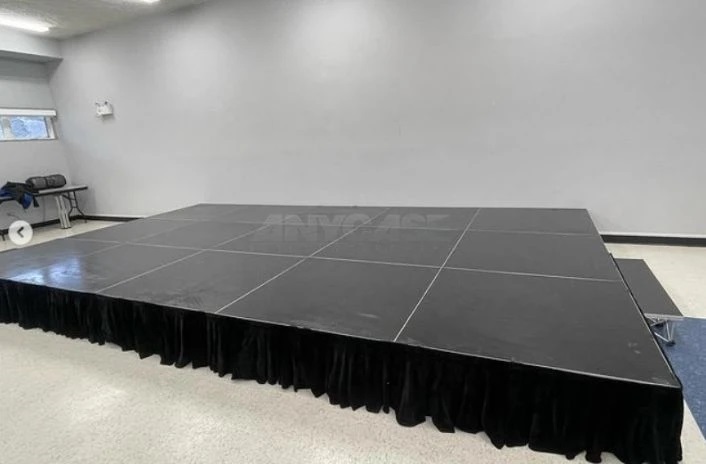
A portable stage is a temporary elevated platform made from sections that can be transported, assembled, removed, and stored. In the event industry, these systems are often called modular stages, mobile stages, or temporary event platforms.
A modular system normally includes:
- Stage decks: Structural panels that form the performance surface.
- Frames or legs: Components that transfer weight from the deck to the ground.
- Adjustable supports: Parts used to level the stage on suitable surfaces.
- Stairs and ramps: Access equipment for performers, staff, and people with mobility needs.
- Guardrails and skirting: Safety and visual-finish components.
- Roof, canopy, or weather cover: Optional protection for performers and equipment.
- Stage curtains and backdrops: Visual branding and cable-management features.
Stage capacity is not determined by deck size alone. It depends on the platform’s rated live load, dead load, point loads, support spacing, surface condition, wind exposure, and the way equipment is placed. The supplier should provide written technical information for each configuration.
Why Use a Portable Stage For Events?
Event organizers often need a performance area that changes with each venue. A modular stage can be built as a small platform for a school ceremony or expanded for a festival with musicians, speakers, lighting, and audio equipment. This flexibility reduces the need to design a new structure from the beginning for every event.
Flexible Stage Sizes
Modular decks can usually be arranged in different layouts. For example, a 6 m × 4 m platform provides 24 m² of usable surface, while a 10 m × 8 m platform provides 80 m². The correct size should be based on the number of performers, instrument positions, monitors, microphones, cable routes, and safe working space.
Do not select a stage only by audience size. A 100-person acoustic performance may need less space than a 20-person band with drum kits, amplifiers, moving lights, and monitor speakers.
Faster Site Changes
A modular stage can be packed for transport and assembled at different venues. However, setup time depends on the number of modules, ground conditions, roof design, access to the site, crew size, and local inspection requirements. Ask the supplier for a setup schedule rather than relying on general claims such as “quick installation.”
Better Transport and Storage
Individual stage sections are easier to move through doors, loading bays, and narrow access routes than one permanent platform. Before ordering, confirm:
- Vehicle size and payload capacity.
- Number of stage panels and support parts.
- Required storage area.
- Whether lifting equipment is needed.
- Distance from the unloading point to the event site.
Consistent Surface Quality
A level, rigid deck helps performers walk safely and allows organizers to position equipment accurately. A stable surface also reduces movement in microphone stands, speaker supports, and other temporary equipment. The stage must still be installed on a suitable base. A modular platform cannot correct unsafe soil, standing water, severe slope, or unstable paving.
Benefits Of Modular Portable Stages For Concerts And Festivals
Concerts and festivals create more complex loading conditions than many indoor presentations. Performers, instruments, risers, lighting fixtures, cables, monitor speakers, and production staff may occupy the same platform. A modular design helps the production team create separate areas for performers, instruments, and technical equipment.
1. Layouts Can Match the Production Plan
A festival may require a main stage, drum riser, speech platform, side platform, or accessible ramp. Modular components allow the production plan to be translated into measurable sections. A stage drawing should show the deck dimensions, stairs, ramps, front-of-house position, cable paths, emergency routes, and equipment zones.
2. Equipment Loads Can Be Reviewed Before Setup
Stage planning should use a load list. For example:
| Item | Example quantity | Example unit mass | Estimated total |
|---|---|---|---|
| Performers | 8 | 80 kg | 640 kg |
| Instrument and audio equipment | 1 set | 450 kg | 450 kg |
| Lighting and support equipment | 1 set | 300 kg | 300 kg |
| Production staff | 3 | 80 kg | 240 kg |
This example creates an estimated load of 1,630 kg before adding safety factors or checking concentrated loads. The figures are for planning only. The manufacturer or structural engineer must confirm whether the selected stage can carry the actual distributed and point loads.
3. Audience Access Can Be Planned More Clearly
A stage system can include stairs, handrails, ramps, and front-of-stage barriers. These features should be planned at the same time as the deck. Adding access equipment after installation may reduce usable space or block emergency routes.
For public events, organizers should check local accessibility requirements. In the United States, the provide requirements for accessible routes and other facilities. Local law may impose additional rules.
4. Branding Becomes More Visible
Front skirting, printed backdrops, side panels, and roof banners can turn the stage into a clear visual focus. Branding should not cover inspection labels, block ventilation, obstruct sight lines, or create wind risks. Any banner or fabric attached to a roof must be approved for the specific structure and weather condition.
How to Choose the Right Portable Stage For Events
Step 1: Define the Event Program
Write down what will happen on the platform. A speech, fashion show, live band, dance performance, and award ceremony each require different layouts.
Record:
- Number of performers or presenters.
- Largest instrument or equipment item.
- Required microphone and monitor positions.
- Number of entrances and exits.
- Whether a lectern, screen, podium, or backdrop is needed.
- Whether the stage will be used by children, older adults, or wheelchair users.
Step 2: Measure the Venue
Measure the proposed stage area, not only the available open space. Include the audience zone, backstage area, mixing position, cable routes, emergency access, generator location, and equipment unloading route.
Check the surface for:
- Slopes and changes in level.
- Soft soil or recently filled ground.
- Drain covers and underground services.
- Standing water and poor drainage.
- Overhead branches, cables, and structures.
- Vehicle and pedestrian movement.
Step 3: Calculate the Required Deck Area
Use a simple planning formula:
Required stage area = performer area + equipment area + access area + operational clearance.
For example, if a performance needs 18 m² for people, 12 m² for equipment, and 10 m² for access and movement, the initial planning area is 40 m². The final size must also consider stage shape, stairs, ramps, guardrails, and the supplier’s module dimensions.
Step 4: Review Load Capacity
Ask for the following technical information:
- Uniformly distributed load rating.
- Point-load rating and permitted load locations.
- Maximum platform height.
- Maximum unsupported span.
- Approved leg and frame spacing.
- Deck material and slip-resistance information.
- Roof and banner limitations.
- Required ballast or anchoring method.
Do not place heavy speakers, lighting towers, vehicles, or temporary structures on the stage unless the design specifically allows them. A platform can meet its general load rating and still fail under a concentrated load if the load is placed between supports or outside the approved configuration.
Step 5: Check Weather and Wind Exposure
Outdoor stages face risks from rain, wind, lightning, heat, and uneven ground. A roof or canopy increases wind area and may require ballast, anchoring, engineering approval, or a weather-related operating limit.
The recommends moving people to a substantial building or enclosed vehicle when thunderstorms threaten. An event plan should define who monitors weather, who can pause the performance, and how guests leave the site.
The and local occupational safety rules may also apply to electrical systems, lifting operations, temporary power, and work at height. Requirements vary by country and venue, so confirm them before installation.
Step 6: Confirm Access and Accessibility
Choose stairs with secure handrails and a ramp where required. The ramp slope, width, landing space, edge protection, and handrail design should comply with the rules that apply to the event location.
Keep at least one clear route for performers and one route for emergency response when the site plan requires it. Never use a stage ramp as a storage area for cases, cables, or barriers.
Step 7: Compare Supplier Support
Two stages with the same deck dimensions may have different safety documentation and installation requirements. Before purchasing or renting, compare:
- Load tables and configuration drawings.
- Assembly instructions.
- Inspection records.
- Replacement-part availability.
- Delivery and installation service.
- Training for the event crew.
- Weather operating procedures.
- Insurance and compliance documents.
Portable Stage For Events: Installation Process
1. Prepare the Site
Clear loose objects, mark the stage footprint, identify underground services, and confirm that the surface can support the stage and its operational loads. If the ground is soft or uneven, stop and obtain a suitable ground-support solution.
2. Inspect Every Component
Check decks, frames, legs, pins, bolts, handrails, stairs, ramps, and connectors. Look for cracks, bent parts, corrosion, damaged welds, loose fasteners, and missing locking devices. Damaged components should be removed from service until assessed by a competent person.
3. Assemble the Base and Deck
Follow the supplier’s configuration drawing. Confirm that supports are placed at the specified spacing and that all connectors are locked. Do not mix parts from different manufacturers unless the combination has written approval.
4. Level the Platform
Use approved adjustment methods. Do not use loose timber, bricks, random packing pieces, or unapproved materials beneath supports. Check the deck in both directions with suitable leveling equipment.
5. Add Access and Edge Protection
Install stairs, ramps, guardrails, toe boards, and skirting according to the design. Check that handrails are secure and that stage edges are visible in low light.
6. Install Production Equipment
Place equipment according to the load plan. Secure cables so they do not create trip points. Keep power cables separate from signal cables where practical, and protect cables crossing pedestrian routes with suitable cable ramps.
7. Complete a Pre-Opening Inspection
Before performers or guests enter, inspect the full system. Confirm:
- The stage is level and stable.
- All connectors and locks are engaged.
- Stairs and ramps are secured.
- Guardrails are complete where required.
- Loads match the approved plan.
- Electrical equipment has suitable protection.
- Emergency routes are open.
- Weather conditions remain within operating limits.
Record the inspection time, inspector, weather conditions, findings, and corrective actions. Written records help the team manage repeated events and demonstrate that checks were completed.
Common Problems With Portable Stages and How to Prevent Them
Stage Size Is Chosen Too Late
When the stage is ordered after the entertainment plan is complete, the platform may not fit the drum kit, presenter area, or accessible route. Prepare a scaled layout before confirming the order.
Equipment Weight Is Underestimated
Organizers often count performers but forget cases, amplifiers, moving lights, monitors, barriers, and technicians. Use a written load list and ask the supplier to review concentrated loads.
Weather Protection Is Treated as Decoration
A roof, sidewall, banner, or backdrop can change wind behavior. Treat every attached surface as part of the structural and weather review. Follow the supplier’s wind limits and evacuation procedure.
The Ground Is Not Tested
A stage may appear level on hardstanding but settle on soft grass or filled soil. Check ground conditions before delivery. If the surface cannot support the planned load, choose another location or obtain professional ground-support advice.
Access Routes Become Storage Areas
Cases and cable reels often collect beside stairs and ramps during setup. Mark these routes on the site plan and assign a separate storage zone. Keep access routes clear throughout the event.
Unapproved Modifications Are Added
Drilling the deck, welding extra brackets, adding a roof, or attaching large signs can change the approved design. Request written approval before modifying the system.
Buying or Renting a Portable Concert Stage Platform
Renting can suit one-time events or organizations that do not want to store and inspect stage components. Buying may suit venues, touring production companies, schools, and event businesses that use the same system repeatedly.
| Decision factor | Buying | Renting |
|---|---|---|
| Upfront cost | Higher initial payment | Lower initial payment per event |
| Storage | Customer responsibility | Usually included in supplier service |
| Maintenance | Owner must inspect and maintain parts | Often managed by the rental provider |
| Configuration control | More control for repeat users | Depends on available inventory |
| Best use case | Frequent events and long-term operations | Occasional or changing event requirements |
Ask for a complete quotation. Delivery, crew, stairs, ramps, roof systems, ballast, permits, insurance, installation, removal, and overtime may be separate charges.
Safety Standards and Professional References
Temporary event structures are regulated differently across countries and cities. Use the following sources as starting points, then confirm local requirements with the venue, authority, engineer, or qualified safety professional:
- for workplace safety requirements.
- for accessible design references.
- for thunderstorm planning.
- for sustainable event management systems.
- for event production safety resources and industry guidance.
These references do not replace a structural design review or local permit. A competent person should approve the final configuration when the stage includes a roof, large banners, elevated equipment, unusual loads, or a large public audience.
Portable Stage For Events Maintenance Checklist
Inspect the system after every event and before long-term storage. Clean dirt and moisture from decks and metal components. Dry parts before packing them to reduce corrosion and material damage.
- Check deck surfaces for cracks, delamination, warping, or slippery areas.
- Inspect frame welds, legs, pins, bolts, and locking mechanisms.
- Replace missing labels and identification marks.
- Keep stairs, ramps, and handrails in the same inspection program as the deck.
- Store parts on a dry, stable surface.
- Keep assembly drawings and load tables with the equipment.
- Record repairs and remove unsafe parts from service.
For frequent use, create a maintenance log with the inspection date, component ID, condition, repair, and person responsible. This makes it easier to identify repeated failures before the next event.
Frequently Asked Questions About Portable Stage For Events
How high should a portable event stage be?
The correct height depends on audience sight lines, access requirements, venue conditions, and local regulations. A low platform may suit a classroom or small ceremony, while a larger audience may need greater elevation. Confirm the maximum approved height for the selected stage system.
Can a portable stage be installed on grass?
Yes, some systems can be installed on grass, but only when the ground is firm, level, and able to support the planned loads. Wet soil, slopes, underground voids, and recently disturbed ground can create settlement risks. A site assessment should be completed before installation.
Can a portable stage support a roof?
Some systems are designed for roof structures, while others are not. A roof adds wind load and may require ballast, anchoring, engineering calculations, and weather limits. Never attach a roof or banner without written approval for the exact configuration.
How much weight can a portable stage hold?
There is no universal capacity. The rated load depends on the manufacturer, deck size, support spacing, height, and configuration. Request the official load table and have the supplier review both distributed loads and point loads.
Is a portable stage suitable for a concert?
Yes, if the stage is designed for performers, instruments, production equipment, access systems, and outdoor conditions. A concert plan should include a stage layout, equipment load list, cable routes, weather procedure, audience barriers, and emergency access.
Do portable stages need permits?
Some locations require permits, structural documentation, fire review, electrical approval, accessibility review, or event-specific insurance. Requirements depend on the country, city, venue, stage height, roof design, audience size, and event duration. Contact the venue and local authority before delivery.
How long does it take to install a modular stage?
Installation time varies with platform size, roof type, ground preparation, transport distance, crew size, and inspection requirements. Request a written schedule based on the exact configuration instead of using a general time estimate.
Next Steps for Planning Your Portable Stage For Events
Start with a measured site plan, event program, equipment load list, access requirements, and weather procedure. Send these details to a qualified supplier and request configuration drawings, load ratings, installation instructions, inspection records, and a complete quotation.
Before the event, read the user guide, brief the installation crew, confirm the inspection process, and check the local rules. If you need help comparing modular layouts or planning a modular portable stage rental for festivals, contact ANYCASE with the event date, location, stage size, expected load, audience capacity, and required accessories. This information allows the supplier to recommend a safer and more practical portable concert stage platform for your next production.
